Home / Services / Explosives Safety and Site Planning

Explosives Safety and Site Planning

We site, size and verify facilities that store or process explosives, so that separation distances and structures meet the governing safety rules.

Scope of work

What PNH Does

Hazard-division siting

Quantity-distance checks for HD 1.1 to 1.6 storage, processing and test areas.

Magazines and storage

Above-ground and earth-covered magazines and containerized storage.

Confined explosions

Test cells and process bays, including venting, frangible panels and quasi-static pressure.

Thermal and fragment hazards

HD 1.3 thermal flux, fragment throw and standoff optimization.

Safety documentation

Siting calculations and net explosive quantity review.
Quantity-distance arcs and hazard divisions
Quantity-distance arcs around a potential explosion site, and the six hazard divisions Plan view with four arcs around a potential explosion site: intermagazine, intraline, public traffic route and inhabited building distances. Exposed sites outside their arcs carry a check; an inhabited building inside its arc is flagged for relocation or mitigation. Below, plain-language definitions of hazard divisions 1.1 to 1.6. PES ! Relocate or mitigate IBD PTRD ILD IMD Arcs from the potential explosion site IMD Intermagazine distance ILD Intraline distance PTRD Public traffic route distance IBD Inhabited building distance Exposed site outside its arc ! Inside its arc: relocate or mitigate Arcs are drawn as circles for clarity. Required distances depend on the hazard division, the net explosive quantity, structure types and orientation, under the governing criteria. Hazard divisions (UN Class 1, plain-language summary) HD 1.1 Mass explosion hazard HD 1.2 Projection hazard, no mass explosion HD 1.3 Fire hazard, minor blast or projection hazard HD 1.4 Minor hazard, effects confined to the package HD 1.5 Very insensitive, with a mass explosion hazard HD 1.6 Extremely insensitive, no mass explosion Schematic. Not to scale. Not for design. Compatibility groups and siting values not shown.
Each exposed site must sit outside its arc from the potential explosion site, and the hazard division drives which arcs apply.
Test cell venting through a frangible panel
Confined explosion in a test cell: frangible panel venting and the effect on gas pressure Section through a reinforced concrete test cell with an internal event. A frangible panel in one wall vents pressure toward an earth barricade. Below, a qualitative pressure-time sketch shows reflected shock peaks, then gas pressure that stays high when unvented and decays quickly when vented. Reinforced concrete cell Internal event Frangible panel vents pressure Barricade Controlled vent direction Pressure at the cell walls (qualitative) Time Pressure Reflected shock peaks Gas pressure, unvented Gas pressure, vented Schematic. Not to scale. Not for design.
Venting through a frangible panel does not change the first shock peaks but cuts the gas pressure that follows, so walls and vent direction are designed together.
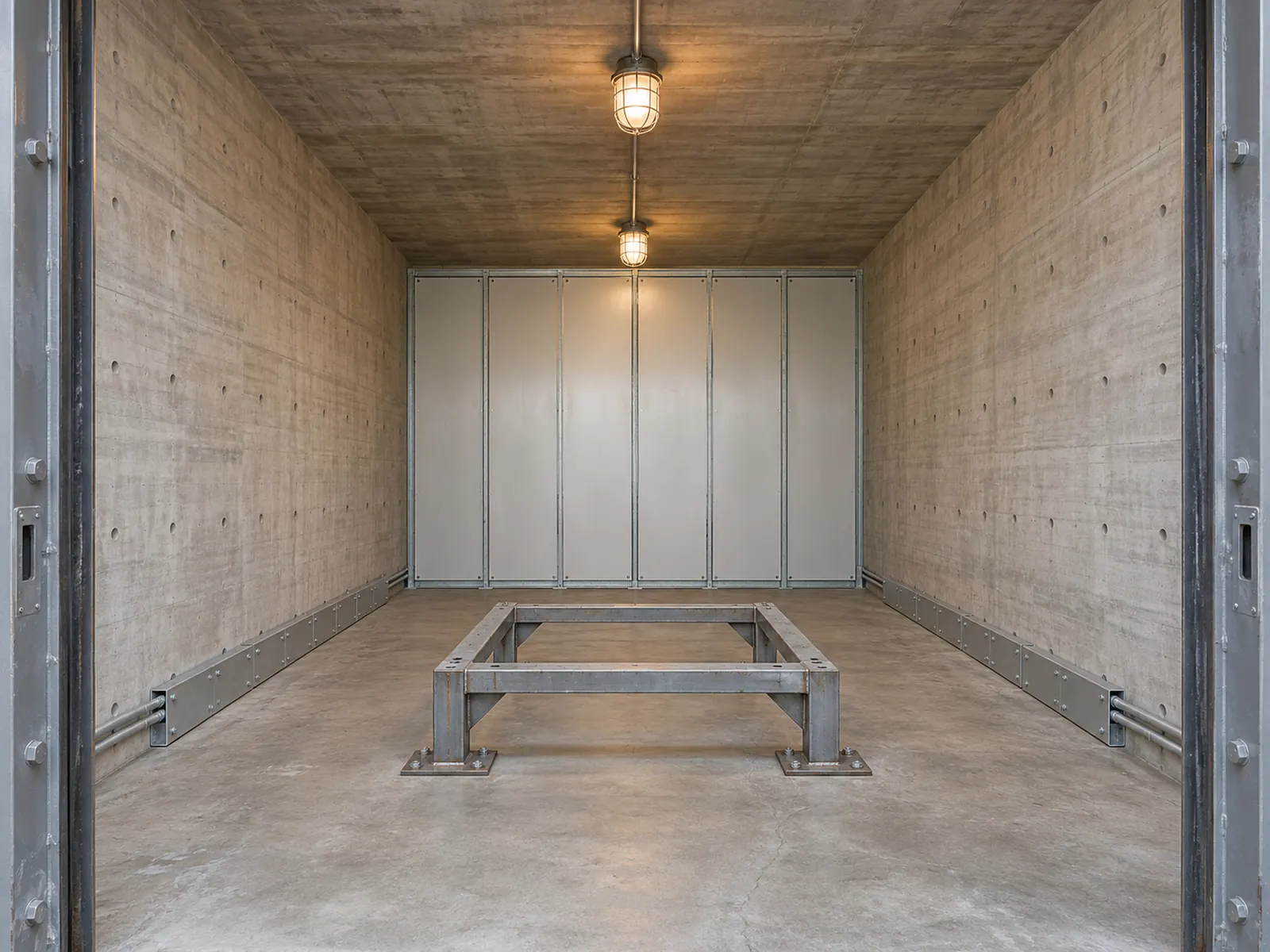
Concrete test cell interior
Interior of an empty reinforced concrete test cell with a steel test stand and one wall of lightweight panels
A hardened test cell: heavy reinforced concrete with a lightweight wall section designed to vent.
Earth-covered magazine section
Earth-covered magazine, longitudinal section: headwall, blast door, structure and earth cover Longitudinal section through an earth-covered magazine. A reinforced concrete headwall with a blast door faces a concrete apron. A steel arch or reinforced concrete structure is covered by earth on the top, sides and rear. A ventilator passes through the cover. Reinforced concrete headwall Blast door Concrete apron Earth cover Ventilator Rear wall Steel arch or reinforced concrete structure Stored items The headwall and door face the apron; earth covers the top, sides and rear. Orientation matters: distances from the front, side and rear of a magazine are treated differently. Schematic. Not to scale. Not for design.
The headwall, blast door, structure and earth cover work together, and a magazine's front, sides and rear are treated differently in siting.

Independent and Engineer-Led

PNH does not make, sell or install protective products. Analysis is performed in house with PNH's own tools and issued under the review of PNH's Chief Technical Officer. Every assumption is documented and traceable to the governing criteria.

Explosives Safety and Site Planning: Common Questions

What is quantity-distance?

Quantity-distance sets the minimum separation between a potential explosion site and the things around it, such as other magazines, inhabited buildings and public roads, based on the hazard division and the net explosive quantity.

Can you support containerized storage of explosives?

Yes. PNH supports the design, blast assessment and certification submittals for containerized storage, including HD 1.3 thermal and fragment hazards.

Discuss Your Explosives Safety and Site Planning Project

Send us the site and the deadline. A short note on the site, what concerns you and when the tender or decision is due is enough to start. We reply within one business day.

  • The siteAn address, a site plan or a few photos.
  • The concernThe threat question, an incident or a client requirement.
  • The criteriaAny standard or client specification that applies.
  • The dateWhen the tender, review or decision is due.

Email pnhsec@pnhsec.com or call +1-818-253-9557

Thank you. PNH will reply within one business day.